Can Foreigners Buy Property in Dubai? Rules, Rights and Restrictions Explained
I’ll cut straight to it: yes, foreigners can buy property in Dubai. Full stop.
📋 Table of Contents
- The Legal Framework: How Foreign Property Ownership Works in Dubai
- Where Can Foreigners Buy Property in Dubai?
- Premium Tier
- High Growth Tier
- Emerging Tier
- What Documents Do Foreigners Need to Buy Property in Dubai?
- For Cash Buyers
- For Mortgage Buyers, You’ll Also Need
- For Remote Buyers (Not Physically in Dubai)
- The Full Cost Breakdown for Foreign Buyers
- Restrictions Foreigners Should Know About
- Benefits of Buying Property in Dubai as a Foreigner
- Frequently Asked Questions About Foreigners Buying Property in Dubai
- Do foreigners need a visa to buy property in Dubai?
- Can foreigners buy land in Dubai?
- Is it safe for foreigners to invest in Dubai real estate?
- Can foreigners get a mortgage in Dubai?
- What happens to my Dubai property if I leave the UAE?
- Your Move: Start Investing in Dubai Property as a Foreigner
But that one-word answer barely scratches the surface. Because while Dubai is arguably the most foreigner-friendly real estate market in the Middle East, there are still rules, boundaries, and a few legal nuances that catch people off guard every single week. I’ve seen British expats assume they can buy anywhere in the city. I’ve had Indian investors confused about whether they need a residence visa first. And just last month, a client from Nigeria flew in thinking he needed a local sponsor to purchase an apartment.
None of that is true. But the misinformation is everywhere.
So let’s settle this once and for all. In this guide, I’m going to break down exactly what foreign ownership in Dubai looks like in 2026, which areas you’re allowed to buy in, what documentation you need, and the restrictions that do exist (because yes, there are a few).
The Legal Framework: How Foreign Property Ownership Works in Dubai
Here’s the backstory you need to understand why Dubai works the way it does.
Before 2002, non-UAE nationals couldn’t own property in Dubai at all. The market was entirely closed to foreigners. Then came Decree No. 3 of 2006 (building on an earlier 2002 regulation), which formally established freehold zones where foreigners could purchase property with absolute, permanent ownership rights.
This was a game changer. Not just for Dubai, but for the entire Gulf region.
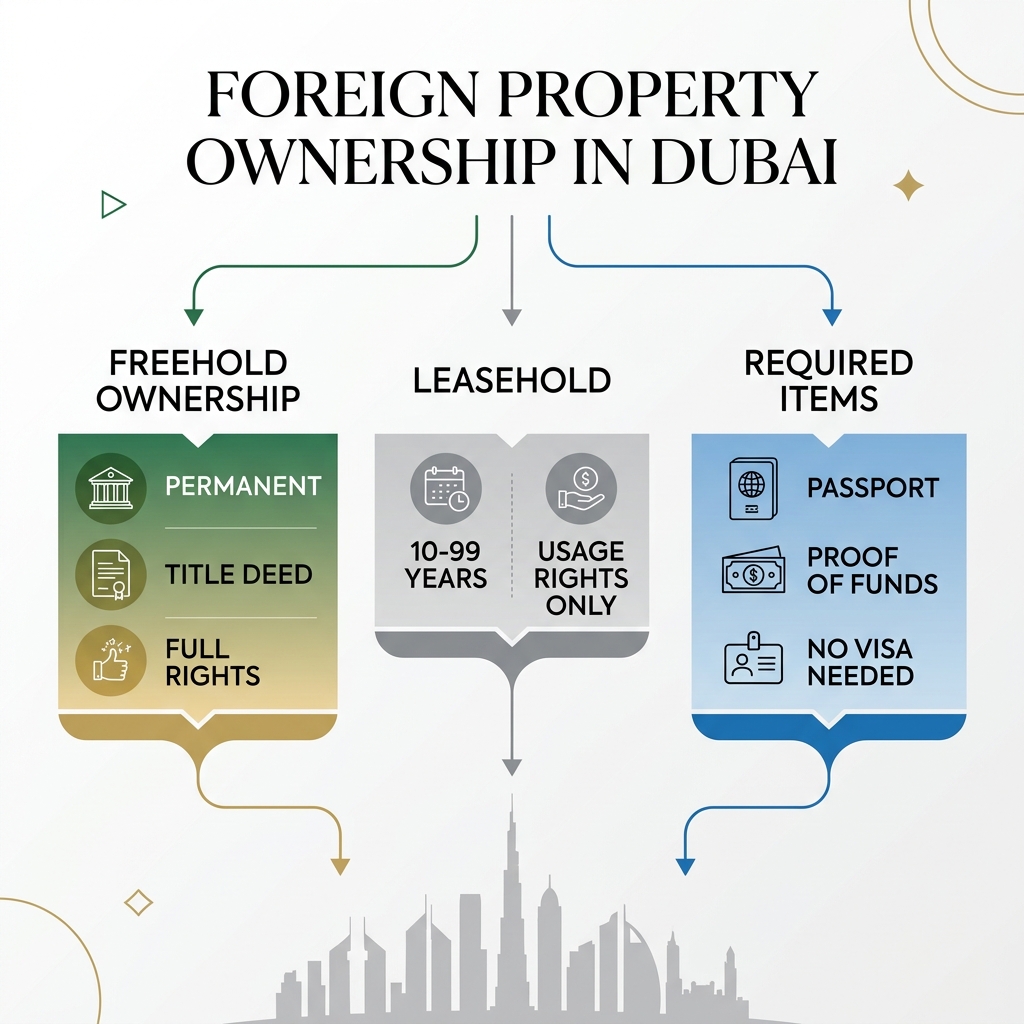
Today, when a foreigner buys freehold property in Dubai, the ownership is registered at the Dubai Land Department (DLD) directly in the buyer’s name. You get a Title Deed. You own the property outright. There’s no expiry, no time limit, and no local partner required. You can hold it, sell it, rent it out, or pass it to your heirs. It’s yours.
But there’s a critical distinction that trips people up: freehold vs. leasehold.
In freehold zones (think Dubai Marina, Downtown Dubai, JVC, Palm Jumeirah), you own the property permanently. In leasehold areas, you only have the right to use the property for a set term, usually 10 to 99 years. The land underneath still belongs to the original landowner. And here’s the kicker: banks are far less willing to provide mortgages on leasehold properties, and they don’t qualify for the Golden Visa.
So when someone asks “can foreigners buy property in Dubai?” the answer is yes, but always buy freehold unless you have a very specific and informed reason not to. We put together a full list of every Dubai freehold area if you want to see exactly where you can purchase.
Where Can Foreigners Buy Property in Dubai?
This is the part that confuses most people. You can’t just buy anywhere. Dubai has designated freehold zones where foreign ownership is permitted, and then there are older, established neighborhoods where only UAE and GCC nationals can purchase.
Here are the most popular freehold areas where foreigners are actively buying in 2026:
Premium Tier
- Dubai Marina
- Downtown Dubai
- Palm Jumeirah
- Business Bay
- DIFC
- Jumeirah Beach Residence (JBR)
- City Walk
High Growth Tier
- Jumeirah Village Circle (JVC)
- Dubai Hills Estate
- Jumeirah Lakes Towers (JLT)
- Dubai Creek Harbour
- Arabian Ranches
- Arjan
- Al Furjan
Emerging Tier
- Dubai South (Expo City)
- Dubai Silicon Oasis
- International City
- Town Square
- Damac Hills
- Meydan
The full list runs to 50+ zones and grows every year as developers launch new master-planned communities. For a complete breakdown with prices and yields, check our Dubai Freehold Areas guide.
One thing I always tell clients: just because an area is freehold doesn’t automatically make it a good investment. Some of these zones have fantastic infrastructure, tenant demand, and proven appreciation. Others are still half-built with limited amenities and spotty occupancy. Do your homework before you write a cheque.
What Documents Do Foreigners Need to Buy Property in Dubai?
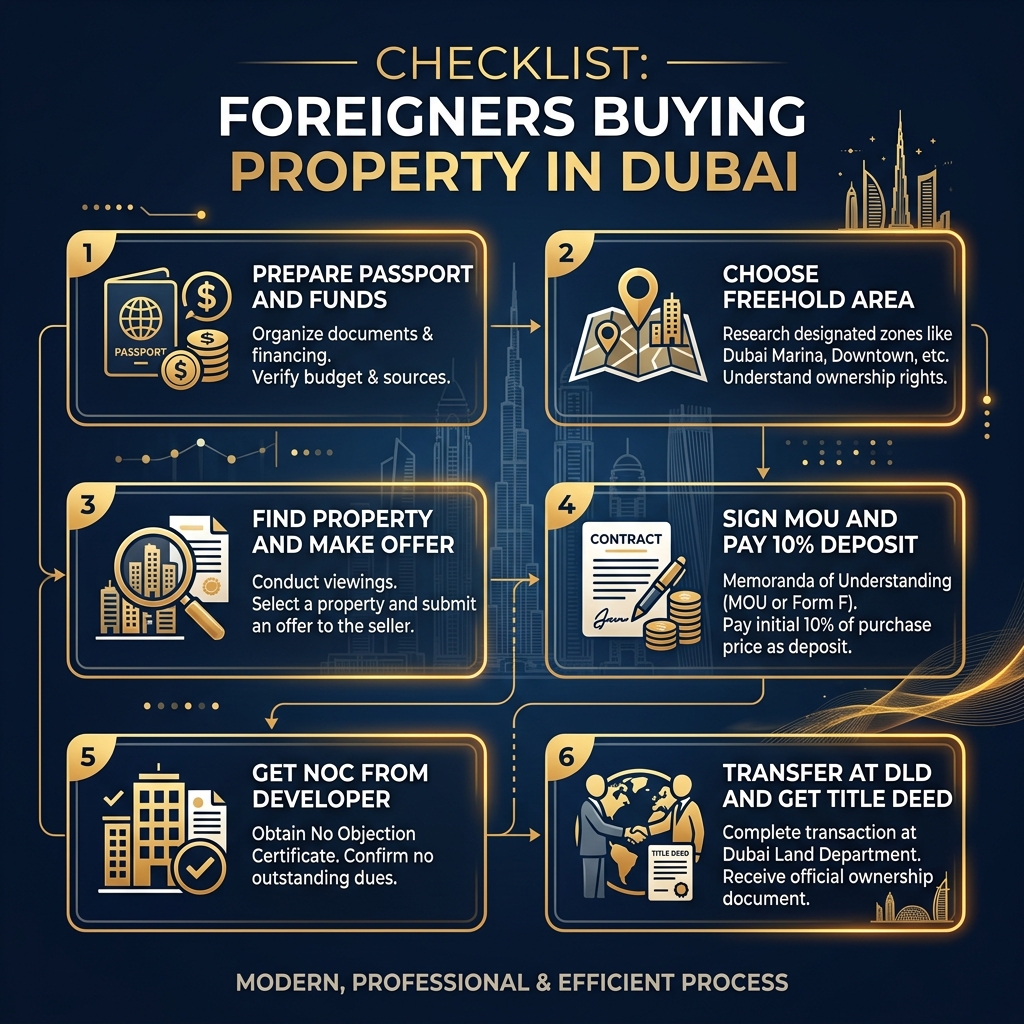
This is where Dubai truly shines compared to other international property markets. The paperwork is shockingly simple. Here’s literally everything you need:
For Cash Buyers
- Valid passport (any nationality)
- Proof of address in your home country
- Manager’s cheques for the property price, DLD fee, and associated costs
That’s it. No residence visa needed. No work permit. No local partner. No bank account even (though having one makes life easier).
For Mortgage Buyers, You’ll Also Need
- Valid passport
- Salary certificate or proof of income
- 6 months of bank statements
- Emirates ID (if UAE resident) or passport copy (if non-resident)
- Mortgage pre-approval letter from a UAE bank
For Remote Buyers (Not Physically in Dubai)
- All of the above, plus
- A notarized Power of Attorney (POA) authorizing a representative to complete the transaction on your behalf
- The POA must be attested by the UAE Embassy in your home country
A client of ours from London purchased a 2BR in Business Bay last quarter without ever stepping foot in Dubai. His lawyer held the POA, attended the DLD transfer, and the entire process took 12 days from signed MOU to Title Deed. It’s genuinely that straightforward.
If you want the complete step-by-step transaction process, we’ve covered it in detail in our Complete Guide to Buying Property in Dubai.
The Full Cost Breakdown for Foreign Buyers
Now, here’s the part that catches first-time foreign buyers off guard. The listed price of the property is NOT the total amount you’ll be spending. There are government fees, agent commissions, and administrative charges that add roughly 7% to 8% on top of the purchase price.
Let me break it down with a real example. Say you’re buying an apartment in JVC for AED 900,000:
| Fee | Amount |
|---|---|
| Property Price | AED 900,000 |
| DLD Transfer Fee (4%) | AED 36,000 |
| DLD Registration Fee | AED 4,000 + VAT = AED 4,200 |
| Agency Commission (2% + VAT) | AED 18,900 |
| NOC Fee (developer) | AED 1,000 to 5,000 |
| Trustee Office Fee | AED 4,200 |
| Total Budget Needed | ~AED 968,300 |
So on a AED 900K property, you actually need about AED 970K ready. That’s a difference of roughly AED 70,000 that many first-time buyers simply don’t account for. I’ve seen deals fall through at the last minute because the buyer didn’t budget for closing costs. Don’t let that be you.
One important note: these fees are the same for foreigners as they are for UAE nationals. There’s no “foreigner tax” or premium pricing from the government. The DLD doesn’t differentiate between an Emirati buyer and a British expat. Same fees. Same process. Same Title Deed.
For a more detailed breakdown, including mortgage-specific costs, check out our upcoming DLD Fees and Transfer Charges guide.
Restrictions Foreigners Should Know About
Let’s talk about the limitations, because they do exist. Dubai is incredibly open, but it’s not a free-for-all.
Location restrictions. You can only buy in designated freehold zones. Areas like Jumeirah, Umm Suqeim, Al Barsha (the older parts), Deira, and Bur Dubai are generally restricted to UAE and GCC nationals. If you fall in love with a villa in one of these neighborhoods, you might be able to secure a leasehold arrangement, but you won’t get freehold ownership.
Company ownership rules. If you want to buy property through a company rather than in your personal name, the company must either be registered in the UAE or be a foreign company with a registered branch in the UAE. There are specific DLD rules around corporate ownership that you’ll want a lawyer to walk you through.
Inheritance considerations. This is the one that surprises people the most. If you own property in Dubai and pass away without a registered will in the UAE, your assets will by default be distributed according to Sharia law, which may not align with your intentions. The solution is simple: register a will with the DIFC Courts or the Dubai Courts. It takes about 30 minutes, costs around AED 10,000, and gives you full control over who inherits your property. I cannot stress this enough, especially for non-Muslim foreign owners.
Mortgage caps for non-residents. UAE banks will finance your purchase, but the terms differ based on residency. If you’re a UAE resident, banks typically finance up to 80% for properties under AED 5 million. If you’re a non-resident, that drops to around 50% to 60%, and not all banks offer non-resident mortgages. HSBC, Emirates NBD, and Mashreq are the most active in this space.
No property taxes, but there are service charges. Dubai famously has zero property tax, zero capital gains tax, and zero rental income tax. But every property carries annual service charges (maintenance fees) that range from AED 10 to AED 30+ per square foot depending on the building and community. These are non-negotiable and must be paid by the owner.
Benefits of Buying Property in Dubai as a Foreigner
Despite the few restrictions above, the advantages of expat buying property Dubai are genuinely unmatched globally. Here’s why foreign investors keep pouring money into this market:
Zero taxation. No annual property tax. No capital gains tax when you sell. No income tax on rental earnings. Your gross yield IS your net yield (minus service charges). Try finding that in London, Singapore, or New York.
Golden Visa eligibility. Purchase freehold property worth AED 2,000,000 or more and you qualify for the UAE’s 10-year Golden Visa. This gives you residency, the ability to sponsor your family, and the freedom to live and work in the UAE without a traditional employer sponsor. It’s one of the most powerful residency-by-investment programs in the world right now.
Strong rental yields. Average gross rental yields across Dubai range from 5% to 9%, depending on the area. Compare that to London (2% to 3%), New York (3% to 4%), or Singapore (2.5% to 3.5%). The math simply works better here.
Currency stability. The UAE Dirham is pegged to the US Dollar at a fixed rate (AED 3.67 = USD 1). No currency risk if you’re a dollar-based investor. And for those coming from currencies that have weakened against the dollar, your rental income effectively gives you a natural hedge.
Transparent, fast transactions. The DLD is one of the most efficient land registries in the world. Blockchain-based title deeds, online verification, and a transfer process that wraps up in days, not months. A cash transaction can literally close in under two weeks.
Frequently Asked Questions About Foreigners Buying Property in Dubai
Do foreigners need a visa to buy property in Dubai?
No. You do not need a UAE residence visa, work permit, or any form of immigration status to purchase property in Dubai. A valid passport from any country is sufficient. However, if you purchase property worth AED 750,000 or more, you become eligible for a 2-year renewable residence visa. At AED 2,000,000+, you qualify for the 10-year Golden Visa.
Can foreigners buy land in Dubai?
Yes, but only in designated freehold zones. You can purchase plots of land and build your own villa or development. However, land purchases come with specific DLD regulations regarding construction timelines, so make sure you understand the obligations before committing.
Is it safe for foreigners to invest in Dubai real estate?
Dubai has one of the strongest regulatory frameworks in the region. The Real Estate Regulatory Authority (RERA), the Dubai Land Department (DLD), and the Escrow Account Law all work together to protect buyers, especially in off-plan transactions. Developer funds are held in escrow, title deeds are blockchain-verified, and disputes are handled by specialized tribunals. Is there risk? Of course, like any investment. But the legal protections here are genuinely robust.
Can foreigners get a mortgage in Dubai?
Yes. Multiple UAE banks offer mortgages to non-residents, including HSBC, Emirates NBD, Mashreq, and Abu Dhabi Islamic Bank. Non-resident LTV (loan-to-value) ratios typically cap at 50% to 60%, meaning you’ll need a larger down payment compared to UAE residents (who get up to 80% LTV). Interest rates in 2026 are hovering around 4.5% to 5.5% for conventional mortgages.
What happens to my Dubai property if I leave the UAE?
Nothing changes. Your ownership is permanent and doesn’t depend on your residency status. You can leave the UAE entirely, live abroad, and continue to own, rent out, and profit from your Dubai property indefinitely. Many of our clients are fully remote investors who have never lived in the UAE.
Your Move: Start Investing in Dubai Property as a Foreigner
The barriers that existed 20 years ago are gone. Today, foreigners buying property in Dubai face fewer restrictions, lower costs, and better legal protections than in most Western markets. The process is fast. The fees are transparent. And the returns, especially in a zero-tax environment, speak for themselves.
Whether you’re an expat already living here or an international investor looking at Dubai from abroad, the market is wide open. The only real question is: which property and which community fits your goals?
If you need help figuring that out, the TBNRE team specializes in exactly this. Reach out, and let’s find the right investment for your situation.
Next up in the series: DLD Fees and Property Transfer Charges in Dubai (2026 Breakdown), where we break down every cost you need to budget for.